History & Heritage
About
the Temple
దేవాలయ చరిత్ర
History & Heritage
దేవాలయ చరిత్ర
Origin & History
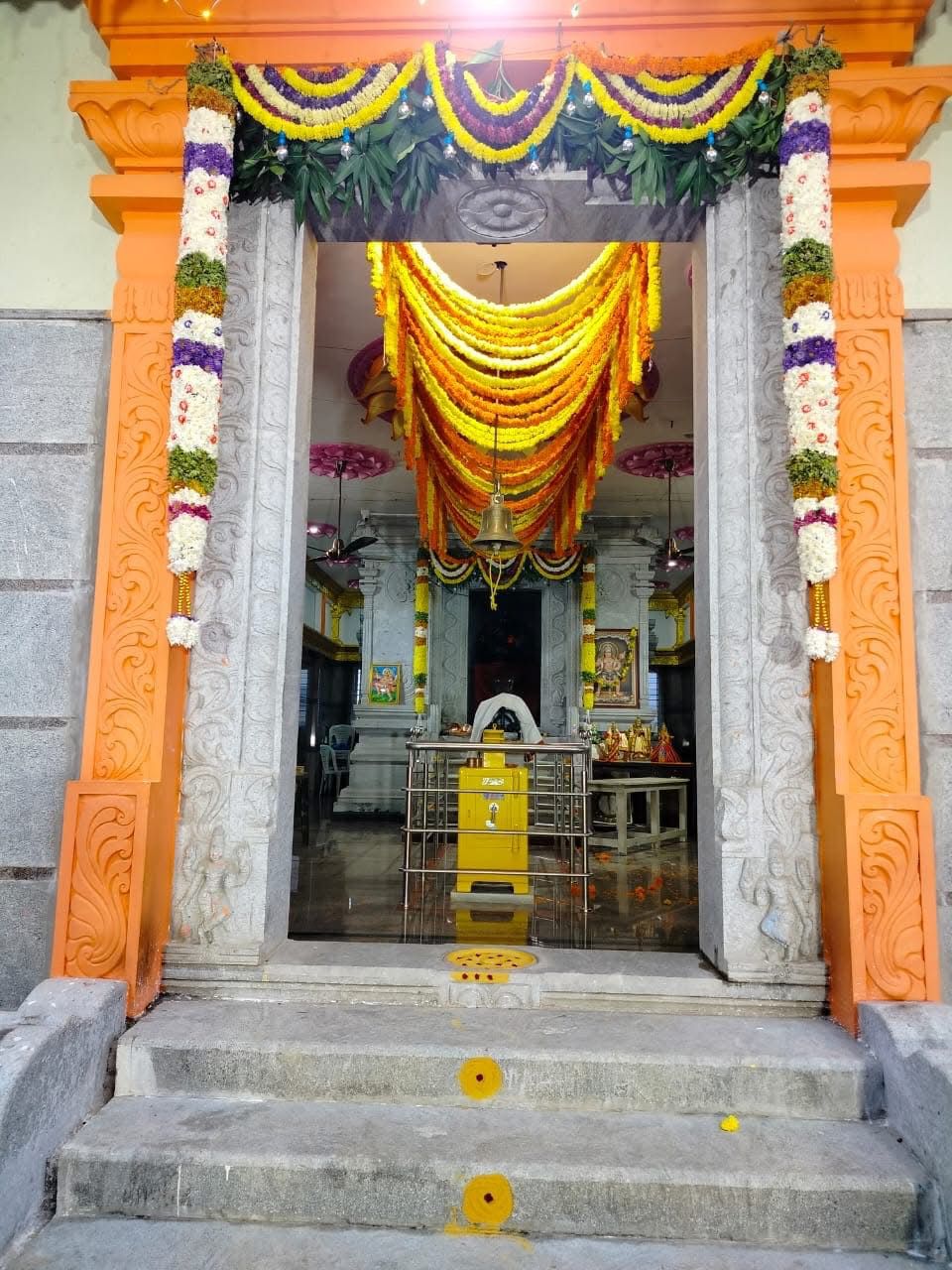
Stand at the entrance and look up at the gopuram. The lower portion is the original — built somewhere around 1900, give or take a decade, when a local farmer named Venkata Reddy consecrated a small granite idol of Anjaneya Swamy at the edge of his field. The story told in the village is that he found the idol buried during ploughing, which is how many great temples in Andhra Pradesh begin. He cleaned it, built a small structure of mud and brick, and invited the village's hereditary priest to perform the first abhishekam.
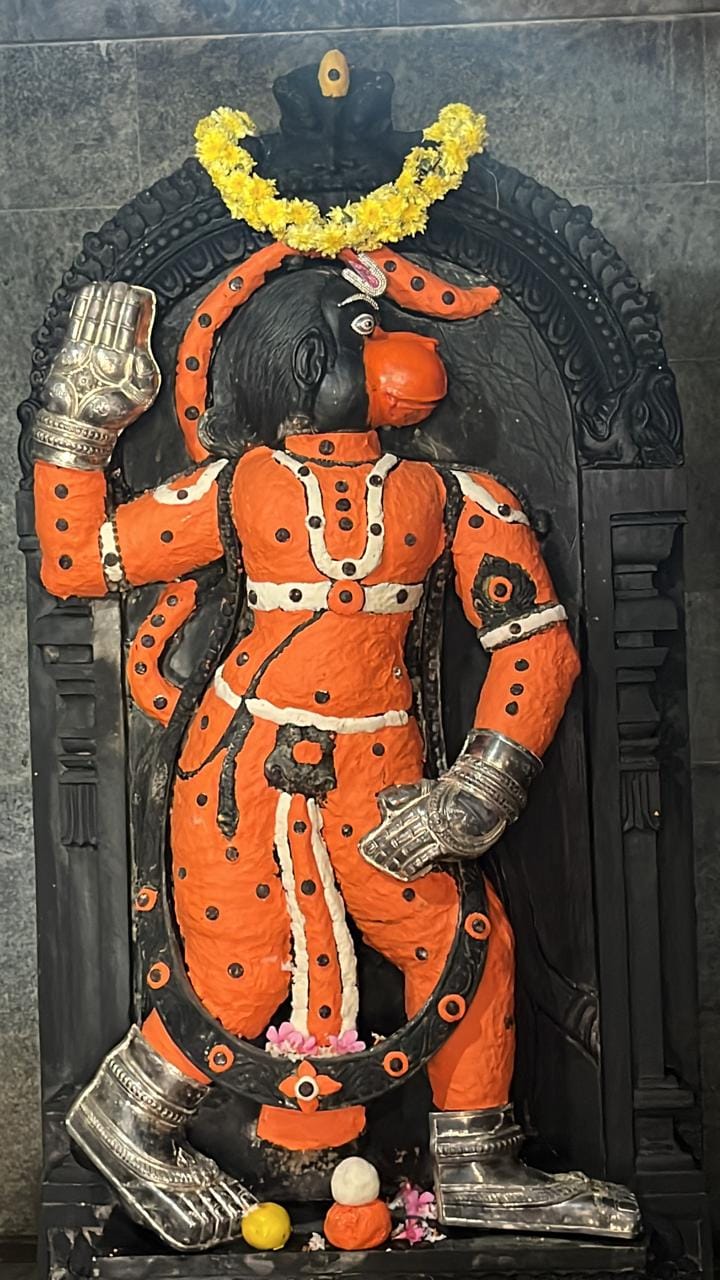
For the first forty years, the temple was no larger than a single room. People came on Saturdays and on Hanuman Jayanti. There was no electricity, no paved floor, no proper gopuram — just a stone idol, camphor smoke, and the priest's voice in the dark. The idol, a standing Anjaneya with the right hand raised in the abhaya mudra and the left hand resting on the hip, was carved from a single piece of Chittoor granite. Whoever carved it knew what they were doing. The proportions, the expression, the stillness of the abhaya hand — it is a serious piece of work.
"The original farmer wanted the deity facing east. The priest said the alignment was already set by the stone's own grain. He was right — this is one of the few Anjaneya idols in the district where the morning sun falls directly on the deity's face during Uttarayana."
The first major expansion happened in 1962, when a group of families from the village and from Chittoor town pooled resources to add the outer prakaara — the enclosed courtyard that gives this temple its distinct quality of depth. Whoever designed it understood that a temple's power is not only in the sanctum but in the journey towards it. The prakaara creates a transitional space: entering, you leave the road behind before you reach the deity.
The gopuram came later, in 1988, funded largely by the Telugu diaspora in Bengaluru, Hyderabad, and Chennai. It was built in the traditional Dravidian style — five storeys, lime plaster, painted stucco figures — and it changed the temple's presence in the landscape completely. You can see it from four kilometres away if you know where to look.
Over the following decades, the kalyana mantapam was added, the lighting was modernized, and the Annadanam hall was built with a grant from an NRI family in 2011. Today, the temple holds formal records in the Chittoor District Endowments Department. The daily puja schedule, the annual brahmotsavam, and the Saturday Abhishekam have remained unchanged for over sixty years.
The hereditary priest lineage — the Doddaballapur family of Tata Venkateswara Sharma — has served this temple for four consecutive generations. The current archaka, Sri Tata Lakshmikanta Sharma, was initiated into service in 1997 and has not missed a single morning Suprabhatam since.
The Presiding Deity
Anjaneya — Hanuman — appears in temples across Andhra Pradesh in many forms: carrying the mountain, kneeling before Rama, leaping over the ocean. Here, the form is Abhaya Anjaneya: standing upright, calm, the right hand raised open-palmed in the gesture that means both "stop" and "do not fear." This is not a deity frozen in a moment of action. This is a deity present.
The granite idol is approximately four feet tall. The carved detail in the tail, the face, and the sacred thread (yajnopavitam) across the chest suggests a sculptor of real skill — more likely trained in the Lepakshi or Tirupati tradition than a village craftsman. The exact origin is unrecorded. The village oral history says "found in the earth." What is certain is that the stone is old, the carving is expert, and the abhaya hand has a quality that devotees describe as watchful.
The idol is decorated differently by season: plain on ordinary days; with silk pitambaram and fresh marigolds on Saturdays; with full panchadhatu kavacham (metal armour) and elaborate flower garlands during Hanuman Jayanti and the brahmotsavam. On the night of Karthika Pournami, the decorations are done entirely in white jasmine.
Temple Governance
The temple is administered by a voluntary trust under the AP Charitable and Hindu Religious Institutions Endowments Act. Committee members serve three-year terms.
Sri Gopalakrishna Reddy
Retired Deputy Collector, Chittoor
Smt. Annapurna Devi
Educator & Community Leader, Sindhurajapuram
Sri Venkata Subbaiah
Chartered Accountant, Chittoor
Sri Tata Lakshmikanta Sharma
Head Priest, Doddaballapur Family Lineage
Sri Ramprasad Naidu
Civil Engineer, Temple Infrastructure
Smt. Sarada Kumari
Women's Welfare & Festival Coordination
Annual Calendar
The temple follows the Telugu lunar calendar for all festival dates. Exact dates for each year are announced one month in advance on the temple notice board and via WhatsApp broadcast.
Makar Sankranti
మకర సంక్రాంతిThree-day celebrations spanning Bhogi, Sankranti, and Kanuma. Special abhishekam each morning, kite flying in the temple courtyard on Bhogi evening, and annadanam for the entire village on Sankranti day.
Hanuman Jayanti
హనుమాన్ జయంతిThe most significant day in the temple's calendar. Devotees arrive from across Chittoor District. The abhishekam runs from 3:00 AM onwards. Chalisa parayanam from 500+ devotees in the main hall. Prasadam distribution through the day. Attendance regularly exceeds three thousand.
Annual Brahmotsavam
వార్షిక బ్రహ్మోత్సవంSeven-day festival following the traditional Agama Shastra. Each day the deity is dressed differently and taken out in procession on a different vahana — the eagle, the bull, the horse. The seventh day Rathotsavam (chariot festival) covers the entire village.
Varalakshmi Vratam
వరలక్ష్మీ వ్రతంWomen's festival with special puja on the Friday before Shravan Pournami. Women from the village and surrounding areas gather for the kalasha pooja at 6:00 AM. Temple is decorated with banana stems, mango leaves, and turmeric.
Karthika Masam
కార్తీక మాసంThe entire month of Karthika (November) is observed with special evening aarti and deepa aradhana. On Karthika Pournami — the holiest night — the deity is adorned entirely in jasmine and hundreds of oil lamps are lit in the prakaara.
Dhanurmasa Puja
ధనుర్మాస పూజMonth-long early morning puja beginning at 5:00 AM throughout Margashira month. Thirupaavai recitations, floral decoration, and special naivedyam each day. Considered especially auspicious for new brides and newly consecrated homes.